
What to Expect at a Repair Café
By Christy McCaw
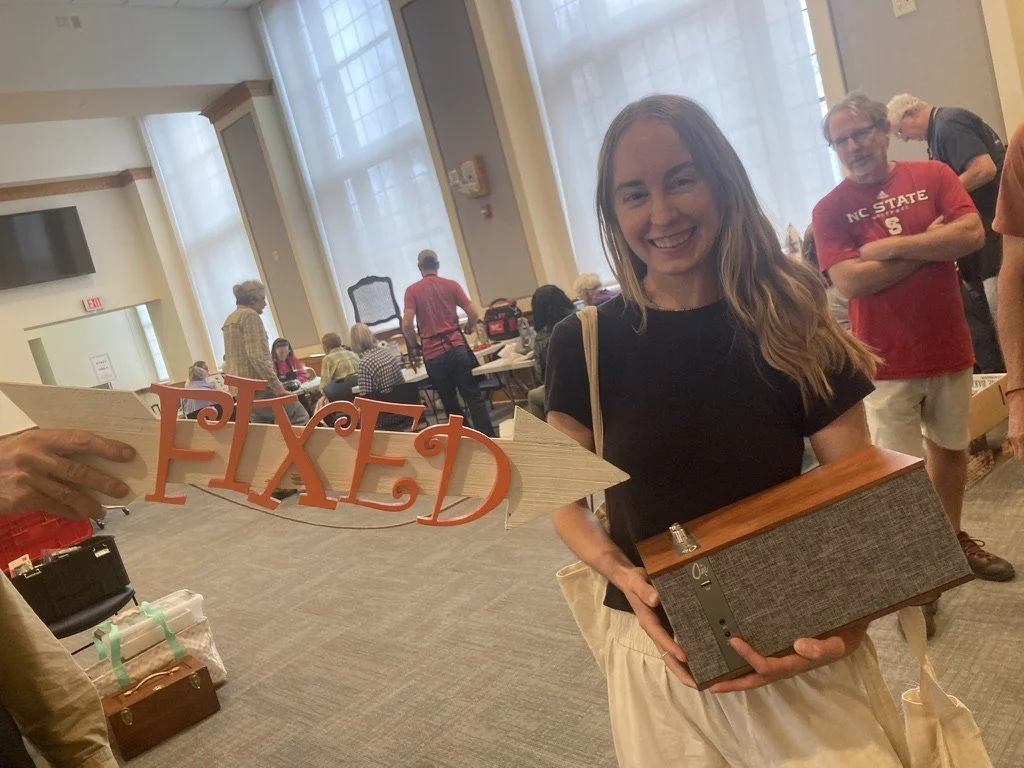
On a warm fall day, I attended a Repair Café at the Whitted Building in Hillsborough, NC.
Repair Cafés are spaces that provide a relaxed environment where neighbors can work on repairing items with the support of coaches.
The concept of hosting Repair Café events (sometimes known as “Fix-it-Fairs”) originated in Europe, but has now spread around the world. Repair Café NC began in Cary in 2017, organized by Tom Karches and Don Fick. These events provide an alternative to throwing something away and buying a new item. The gatherings encourage a sense of stewardship and learning about the items that you have, something that can be countercultural in today’s economic system.
The impact of throwing away household goods is apparent. The City of Durham has publicized that residents produce an average of 1,500 pounds of waste per household annually. According to the NC Department of Environment Quality’s 2023-2024 Division of Waste Management Report, the state of North Carolina produced 14,215,732 tons of waste, with hundreds of tons also being sent to landfills in neighboring states such as Georgia, South Carolina, and Virginia.
Participating in a Repair Café to keep one more item out of the landfill is simple. Attendees are encouraged to register ahead of time through a Google Form. I started to register for a broken Instant Pot, but through the process of looking up a diagram of the product while trying to write a detailed description of the issue, I realized that it was simply missing a small part that I could purchase to fix the issue. Just taking the time to do a small amount of research made this item completely usable again! The Repair Café was already working its magic. I was then able to turn my attention to the different project causing frustration in my home: a Bluetooth speaker that no longer connected via Bluetooth.
“The Repair Café was already working its magic.”
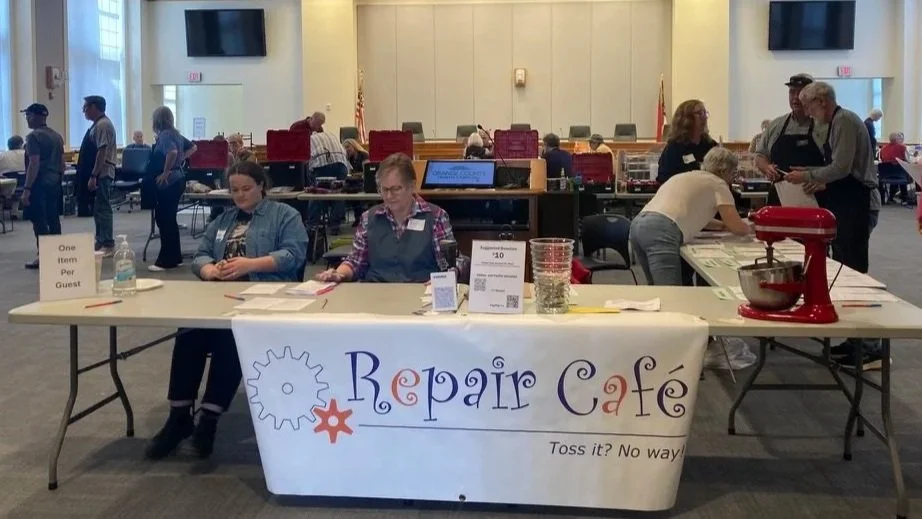
Arriving at the Repair Café, there was a welcome table with friendly volunteers and a sign with the slogan “Toss it? No Way!” Here, you can check in and register your item if you haven’t already online. There are chairs set up where you can wait until the repair coach you are paired with is ready for you. My fellow attendees were a diverse group of all ages, holding things like stand mixers, sewing machines, a scooter, and a broken wooden chair.
The environment is creative, non-intimidating, and it felt easy to strike up a conversation with a neighbor about what they had brought and what they had tried to do to fix it so far. After a short wait, my name was called. I was paired with Bruce as my repair coach. I talked through the issue and how I had tried to fix it so far. We did some trial and error and looked up more about how to fix the issue online. Eventually, after Bruce tried a reset process I swore I had tried before, the speaker was reset and started connecting again.
I got a chance to talk with Don Fick more about the local Repair Café series he helped get started. Don explained that the volunteers are known as repair coaches, not experts, as the term “experts” creates the notion that you need to have training. Volunteers are from all walks of life. Some volunteers may have an engineering background, but many are simply passionate about repair. An important part of the Repair Café is the collaboration and opportunity to share from life experiences. The repair is not done for an attendee, but with them.
“Volunteers are known as repair coaches, not experts, as the term “experts” creates the notion that you need to have training. Volunteers are from all walks of life.“
Another important part of the Repair Cafés, according to Don, is how they encourage meaningful conversation and decrease social isolation. Repair Cafés are people-focused, not stuff-focused. While there wasn’t a specific project that stood out in Don’s mind as most memorable, he said it was always meaningful to work on an item that has memories attached. Don also doesn’t subscribe to the notion that “they don’t make things like they used to,” the idea that newer items are inherently more difficult to repair. In fact, North Carolina’s Repair Cafés have a 70% success rate.
Having an item working in my home again is great, and it feels empowering knowing what to do if my speaker breaks again. But the warmth of the environment at the Repair Café is what really sticks with me. How exciting would it be if repair, and particularly repair in a community setting, became a normalized part of our lives and wider economy? Attending a local Repair Café may be a great place to start.
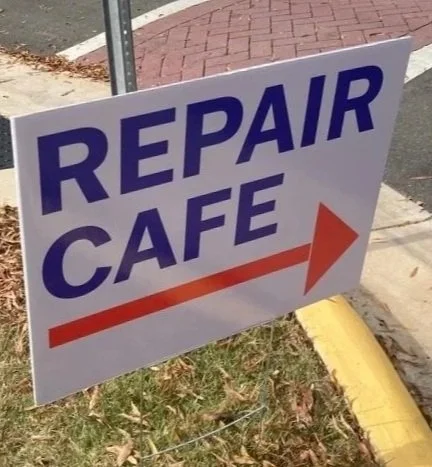
To stay up to date on Repair Café NC and see upcoming events, check out their website at www.repaircafenc.org.
There is no cost to attend, but they accept donations if you’re interested in helping to keep this work going.